Benevento
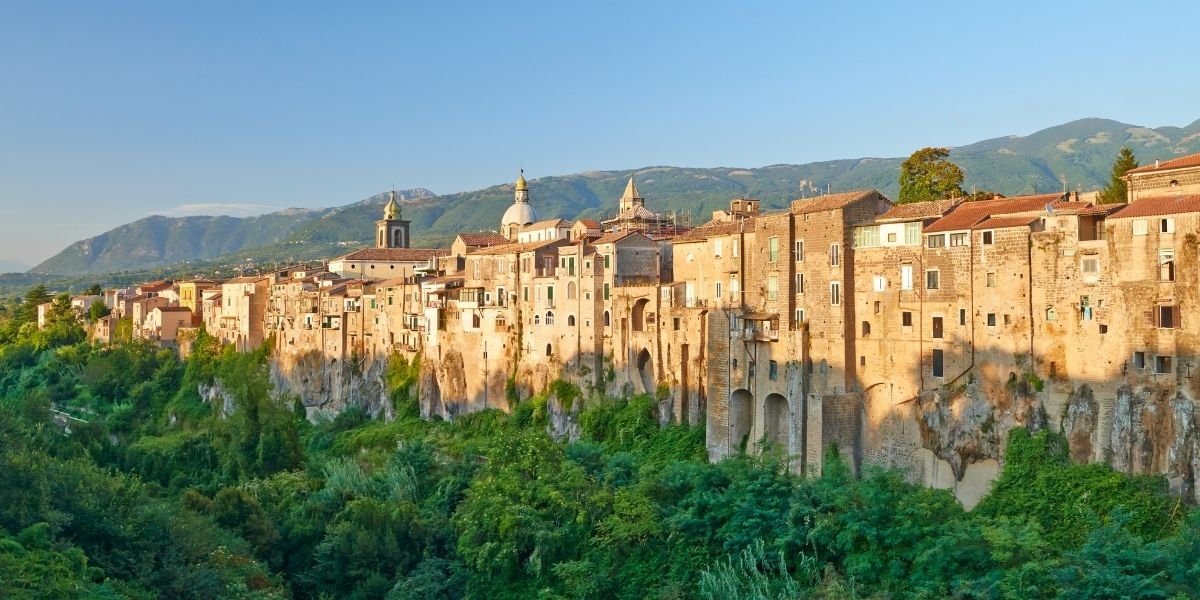
Benevento lies in the Apennine hinterland of Campania, at an altitude of 135 metres, at the confluence of two rivers flowing down from Irpinia, the Calore and the Sabato. It has a population of 55,000. In antiquity it was an important road junction in central and southern Italy.
In pre-Roman times, under the Oscan name of Malventum, it was perhaps the most important settlement of the Hirpini, a Samnite tribe. After their victory over Pyrrhus in 275 BC, the Romans renamed it Beneventum, and it became the first settlement of Roman colonists with Latin rights. The Via Appia ran through the town, and in AD 114 Trajan chose it as the starting point of the Via Traiana, an alternative to the Appian route towards the ports of Puglia.
Benevento still preserves important remains from the Roman period, most notably the monumental Arch of Trajan, which marks the start of the Via Traiana, and the vast Amphitheatre, where Nero attended a gladiatorial show in AD 63. The emblem of the Lombard period (8th century AD) is the elegant Church of Santa Sofia, the national temple of the gens Langobardorum; together with its cloister it is inscribed on the UNESCO World Heritage List as part of the site "Longobards in Italy. Places of Power".
Two of William's miracles are set in Benevento: the 'Healing of a Woman' and the 'Healing of a Blind Girl'. Linked to his journey from Rome towards Melfi is the episode 'St William in Melfi Meditates on the Psalms'.