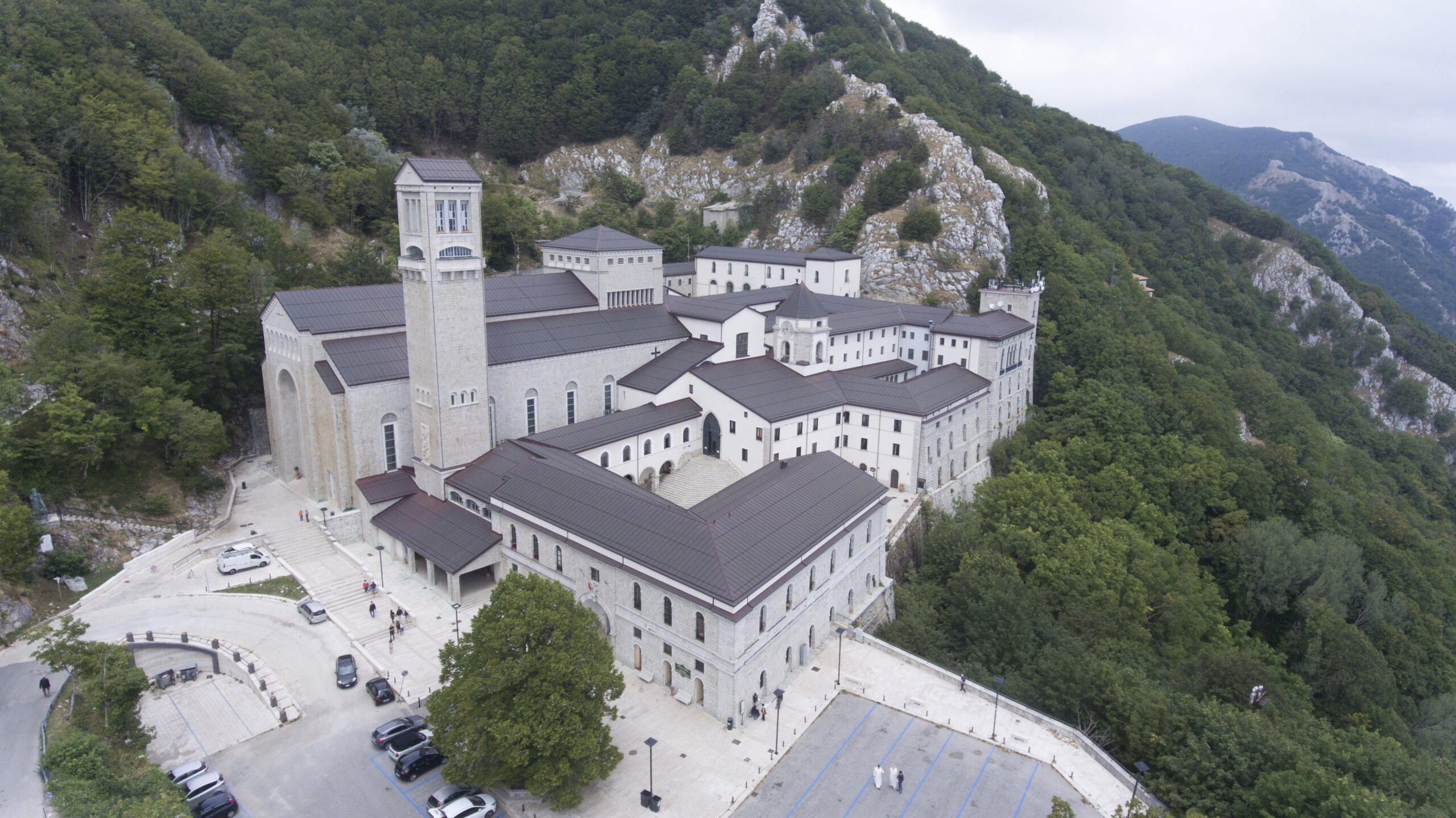
Abbey of Montevergine
The Sanctuary of Montevergine stands in the heart of Irpinia. At an altitude of 1,263 metres, it overlooks the Sabato valley. It is a place of deep spirituality and has been a pilgrimage destination for centuries.
The history of Montevergine is bound up with William of Vercelli, who founded it and built it with his own hands in 1124, 900 years ago. William built a church dedicated to the Virgin, still a pilgrimage destination today, and founded the Montevergine Congregation.
The Abbey of Montevergine can be reached on foot from Mercogliano or Ospedaletto, along the devotional path of the Juta, which coincides with the Cammino di Guglielmo. A road with numerous tight hairpin bends links the abbey with the Avellino Ovest motorway exit on the A16 Naples–Bari motorway.
We recommend going up on the lovely funicular, begun in 1926 and opened in 1956. Over a length of just 1,670 metres it climbs a remarkable 734 metres, with a gradient of between 43% and 63%. It departs from the centre of Mercogliano and reaches the abbey in 7 minutes, passing through chestnut woods and limestone outcrops, with magnificent views over the valley and the Abbey of Loreto.
Be sure to visit the Old Basilica, which houses the miraculous image of the Virgin: a large panel painting of the Madonna of Montevergine, known to the faithful as 'Mamma Schiavona', by Montano d'Arezzo (late 13th century). From there you can visit the new 'cathedral basilica', built in 1952–61 in a style inspired by the Romanesque. Set crosswise on the Baroque church, whose left aisle it incorporates almost entirely, it is of imposing size (54 m long and 25 m wide). The remains of St William lie beneath the high altar. Don't miss the MAM (Museo Abbaziale di Montevergine), whose many works of art include the 'Madonna del Latte' or 'Madonna di San Guglielmo', a fine 13th-century panel painting, and numerous canvases depicting the life of William by Domenico Antonio Vaccaro.
If the sanctuary's quiet offers comfort to the spirit, the climb to the basilica is a feast for the eyes, opening up broad landscapes of chestnut and beech woods, with fine views over the Avellino basin below. (TCI)
The ascent to the abbey offers breathtaking views: to the east stretches the long Picentini range, while to the west you can see the outline of Vesuvius. The CAI's 'Sentiero Italia' passes through here. (AV) Even wider views reward the walk to the summit of Montevergine (1,493 m), in the heart of the Partenio Park: on clear days the view extends as far as the Bay of Naples. (From the Touring Club Italiano Guida Verde 'Campania'.)
From the 'Legenda' of the saint's life we learn that the young William, having come to Irpinia and stopped near Atripalda (Avellino), climbed in 1118 the mountain above Mercogliano (Avellino), choosing it as the ideal place to lead a solitary life and make a refuge of peace and spirituality. Here, near a spring and the ruins of a temple to the pagan goddess Cybele, William built a small chapel dedicated to the Virgin Mary, beside which he made his home. His fame soon spread through the area, and many came to visit the holy hermit. Around him, on the Mountain of the Virgin, a community of seekers of God grew up, to whom William gave a Rule of life inspired by St Benedict's 'Regula monasteriorum'. The Congregation of the Monks of Montevergine spread rapidly across southern Italy. Thus arose the largest and most important Marian sanctuary in southern Italy, where the 'Madonna di Montevergine', or 'Mamma Schiavona', is still venerated today.
Montevergine appears many times in the 'Legenda', which also recounts several miracles. The following are the titles of the chapters in 'Episodi della vita di San Guglielmo' by Giovanni Mongelli OSB: 'The Bear that Muddied the Water', 'The Building of the First Church', 'The Episode of Gualtiero the Ligurian', 'The Legend of the Doves', 'The Healing of a Mute Woman' and, surely the best-known episode of all, 'The Legend of the Wolf and the Donkey'.